Skip to content
Contract-aware revenue integrity for hospitals and health systemsEvery finding cites the contractReport-only, your team decidesHIPAA BAA signed before any data moves

HomeMax Allowable Audit

Your chargemaster against your contracts

Max Allowable Audit

The Max Allowable Audit sets your chargemaster against your contracts. Many commercial contracts, and some Medicare and Medicaid fee schedules, pay the lesser of the contract amount and the hospital's billed charge. When a chargemaster price sits below the contract, the payer pays the charge, the payment is correct, and the difference is gone. The audit measures that loss from your own remittances, quotes the clause that governs each service line, and gives your billing office and CDM committee a clear, compliant basis to act.

The Lost to Cap dashboard: 25,758 remits priced, 1,026 paid at the full billed charge and $1,435,715 lost to the cap, by payer and month, with what was paid and what the cap kept each month
Demo Hospital account · payer and patient identifiers blurred

The lesser-of trap

How a charge caps a payment

The loss begins with a gap between two systems the hospital owns. Managed care negotiates contract rates, and those rates rise at each renewal.

The chargemaster is kept by a separate team on its own schedule, and its prices often stay where they were set years before. Once a contracted rate passes the charge for the same service, every claim for that service under that contract is paid at the charge. Consultants who study hospital pricing call this the lesser-of trap, and it grows with every rate increase the hospital wins.
Max Allowable: once the contract rate passes the hospital's charge, the payer pays only the chargeContract rateYour chargeWhat the payer paysLost to the capThe rate passes the chargeLost to the capCharge above the rate: paid at contractContract rateYour chargealso what thepayer paysYear 1Year 2Year 3Year 4Year 5Year 6Contract years, one service under one payer. Illustrative shape, no dollar scale.
Max Allowable: once the contract rate passes the hospital's charge, the payer pays only the chargeContract rateYour chargeWhat the payer paysLost to the capRate passes chargePaid at contractY1Y2Y3Y4Y5Y6Contract years. Illustrative shape.

Lost to Cap and Contract Basis

Two views of the same contract

The Max Allowable Audit works in two views that read the same coded contracts and the same claim history. Lost to Cap measures the loss. Contract Basis explains it, one service line at a time, in the contract's own words.
View 1 · the measured loss

Lost to Cap

On the 835, when the payer's payment plus the patient's share equals the billed charge to the cent and the contract prices higher, the charge set the payment. The engine records the difference as lost to the cap and shows it by hospital, setting, payer, plan column and period, per 1,000 claims and as a share of expected allowed. Every number opens to the remits behind it, largest loss first. A capped payment is a correct payment, so this loss is never added to a recovery total and never appealed.
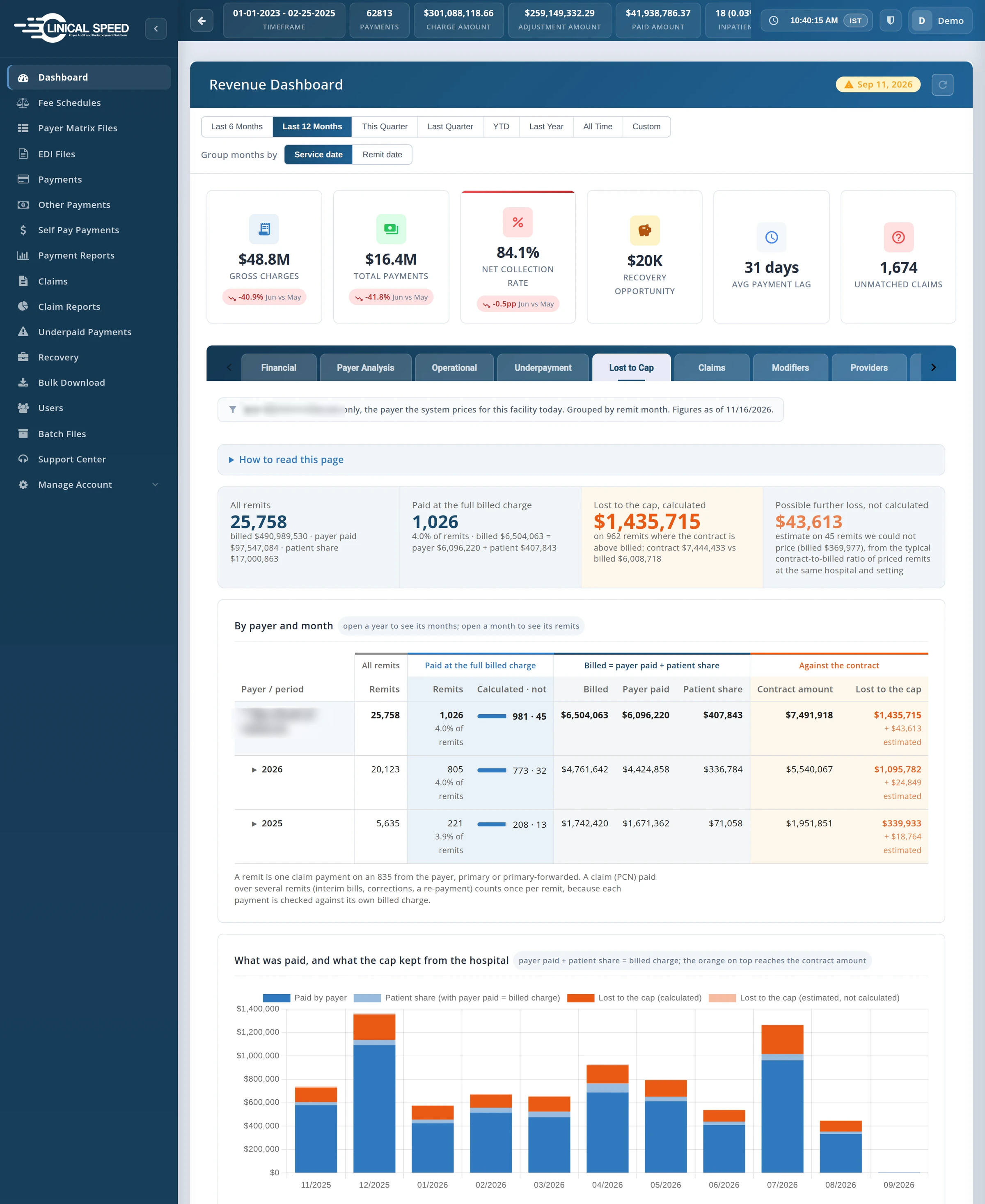
The Lost to Cap dashboard: 25,758 remits priced, 1,026 paid at the full billed charge and $1,435,715 lost to the cap, by payer and month, with what was paid and what the cap kept each month
Demo Hospital account · payer and patient identifiers blurred
View 2 · the clause behind it

Contract Basis

One screen per service line and payer contract. It quotes the lesser-of clause and the rate clause verbatim with a pin cite (agreement, amendment, effective dates, exhibit, section and page), shows how the hospital's charges sat against the contract over the lookback, lists the bundled services billed inside a per diem or case rate, and charts billed, expected and paid month by month with chargemaster updates and renewals marked. Each quote is matched to the stored contract text before it is shown.

Worked example

A worked example from the Demo Hospital account

The Demo Hospital account is a de-identified copy of a real health system's results. The claim below is illustrative, modelled on a real two-hospital case study, so no negotiated rate is shown. It is a six-day inpatient stay priced under the contract's reciprocity column for members of an affiliated plan. The contract pays inpatient care as a per diem by accommodation row, at $4,100 a day, which comes to $24,600 for the stay. The hospital billed $19,900, and the payer paid that amount to the cent, $18,400 from the payer and $1,500 from the patient. The labs, drugs and operating room lines show zero under CARC 97, correctly included in the per diem. The claim was paid in full and still lost $4,700, because the hospital's own charge set the payment.

Worked example, six-day inpatient stay
ItemAmount
Contract allows, 6 days at $4,100$24,600.00
Billed charge$19,900.00
Payer paid plus patient share$19,900.00
Lost to the cap$4,700.00
Lost to Cap · one remit

A six-day inpatient stay, paid in full

The contract pays $4,100 a day. The hospital billed $19,900, and the payer paid that charge to the cent.

Payer paid $18,400.00Patient share $1,500.00Gap $4,700.00
Lost to the cap$4,700.00

Illustrative claim, modelled on a real two-hospital case study

Across the period shown in the same account, 25,758 remits were priced, 1,026 were paid at the full billed charge, and the hospital lost $1,435,715 to the cap. The fix is a chargemaster decision. A claim billed at the price in effect on its date of service is billed correctly, so no paid claim is ever rebilled.

Case study

One client, one payer, twelve months

In a case study for a two-hospital health system in California, the Max Allowable Audit found more than $4.4 million a year in the client's own charges billed below its contract with one commercial payer, about $367,000 a month across 3,600 claims over twelve months. One claim in that audit was paid $28,950.11 against a contract amount of $38,489.93, a loss of $9,539.82 on a single claim. The payer paid every one of these claims correctly under the contract, so the client stops the loss going forward by correcting its chargemaster.

Case study · one client, one payer, twelve months. An example from one client, not a projection. Every hospital's contracts and results differ.

$4.4M+a year in the client's own charges below its contract with that payer
$367Ka month, stopped going forward through the chargemaster
3,600claims billed below the contract in twelve months
$9,539.82lost on one claim in this audit

Deliverables

What the audit delivers

See it on a demo

The CDM Repricing Proposal

For each chargemaster line driving the cap, the uniform increase that would clear it, with its all-payer effect shown first: percent-of-charge contracts, charge-increase limits, stop-loss and outliers, self-pay prices and the price-transparency file. Your committee sets the price.

For the CDM committee

The Basis Brief

A plain-language rationale for each service line and contract, written for the billing office, the CDM committee, managed care and compliance. It quotes the clause with its pin cite, shows the arithmetic, states the data period and names the compliant paths that apply.

For billing, CDM and compliance

Contract negotiation evidence

Clause-level evidence for managed care: how often the lesser-of clause fired, on which service lines, against which plan columns and what it cost, so the clause can be narrowed and charge-increase limits reset at the next renewal.

For managed care

Pre-Submission Contract QA, included

Every outbound 837I and 837P is priced before it leaves: expected allowed by line with clause references, the cap-risk flag, denial and underpayment risk, missing elements, bundling conflicts and clause-cited evidence packs.

Included with the audit
Commercial terms

A one-time installation and training fee plus contingency, set in the proposal.

Request a proposal
COMPLIANCE

The compliant boundary

Charges must be uniform. One chargemaster price applies to every patient and every payer, so the fix for a capped payment is a dated chargemaster change adopted by the hospital's committee for every payer. The product contains no per-claim or per-payer price suggestion of any kind, and it never rebills a paid claim at a new price. Each hospital's contract terms, rates and chargemaster are computed only from that hospital's own data. Every proposal shows its effect on percent-of-charge contracts, stop-loss, self-pay prices and the price-transparency file before it leaves the screen.

WHY IT STAYS HIDDEN

Why the loss stays hidden

A capped payment looks perfect on every standard report, since the claim is paid in full, the account closes at a zero balance, no denial is recorded and no adjustment is written off, so nothing routes it to a work queue. Underpayment vendors pass over it, since the payer owes nothing and there is no appeal to file. Chargemaster software prices services against market and cost data, and it has no view of the specific remits and contract rates where the cap took effect. Clinical Speed reads both the contract and the remittance, which is what this loss requires.

Request a demo

See Lost to Cap and Contract Basis on a demo

The demo shows the remits behind every number and the clause behind every service line, on the de-identified Demo Hospital account.