Two anchors for every line
The floor that clears every contract's cap, and the ceiling of what comparable hospitals publish.
HomeClinical Speed ForwardChargemaster Pricing Review
Clinical Speed Forward · Program 1
When your price sits below what a contract would pay, the payer pays your price, and that loss can never be appealed. We show where it happens and the one fair price, for every payer, that stops it.
One price for every payer. Built only from lines whose payment moves with the charge, and recalculated after confirmed missed charges. Your committee decides.
| Your contracts | Comparable hospitals | One price, every payer | ||||
|---|---|---|---|---|---|---|
| Chargemaster line | Today | Max Allowable floor | Peer median | 75th pct | Suggested | Floor to ceiling |
| ED visit, level 40450 · 99284 · 4 of 7 payers capped | $1,850 | $2,140 | $2,610 | $3,050 | $2,480 | |
| Laparoscopic cholecystectomy0360 · 47562 · 5 of 7 payers capped | $14,200 | $16,900 | $18,400 | $21,700 | $17,600 | |
| Hospital outpatient clinic visit0510 · G0463 · 4 of 7 payers capped | $318 | $402 | $455 | $540 | $430 | |
| CT abdomen and pelvis, with contrast0350 · 74177 · no payer capped | $2,050 | $1,780 | $2,690 | $3,120 | Hold | |
Chargemaster Pricing Review · the question it answers
The floor that clears every contract's cap, and the ceiling of what comparable hospitals publish.
Your tiers in order and priced fairly, with a new published tier only where your own claims show it.
Prices change going forward, published before they are billed, and your committee decides each one.
Deliverables
Each priced service against comparable hospitals at local, state and national level: the gap to the peer median, the percentile rank and the price as a multiple of Medicare, rolled up by department and service line. Refreshed monthly, with no separate fee.
Your existing levels and tiers checked for order, look-alike lines flagged and sister facilities compared under the same charge code, each level priced on its own, and a new published tier proposed only where your own claims support it.
Every line where your price sits below what a contract would pay, with the contract wording beside the charges. The floor is the lowest single price that clears every payer's cap.
One recommended price per line, between the floor and the ceiling, with its side effects listed first: percent-of-charge contracts, self-pay bills and your published price file.
After your committee adopts a price, the returning 835s show the gain on paid claims, so every change is measured on real payments, not on a forecast.
A finding inside the review
Lost to Cap measures past payments capped by your own price, by payer, service line and month. When the payer's payment plus the patient's share equals your billed charge to the cent and the contract prices higher, your charge set the payment. Those claims look paid in full, close at a zero balance and never reach a work queue, so standard reports miss them.
Lost to Cap is evidence for a price change. Past claims are never repriced, so it earns no fee: it shows your committee where the floor matters most.
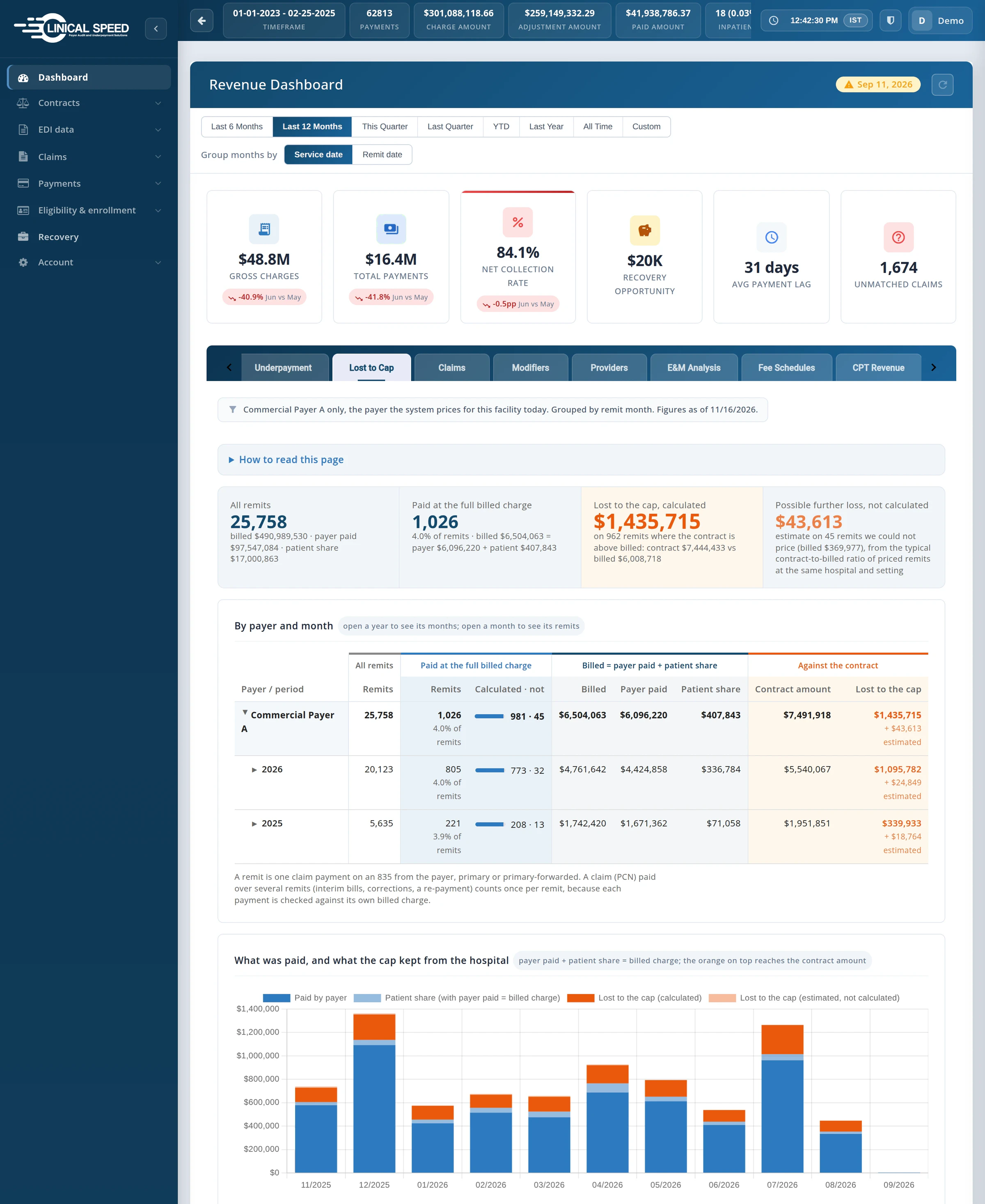
Contract rates rise at each renewal, while a chargemaster price can stay where it was set years before. Once a contract rate passes your charge, a lesser-of clause pays only your charge. The Max Allowable floor is the price that stops it.
Inside the program
Many hospitals already have levels: nursery and NICU levels, clinic visit levels, surgery complexity tiers, time-based effort tiers and separate room types. We keep your structure and price each tier to the highest fair amount the evidence supports.
Where your claims show a heavier day that repeats, such as a defined set of labs, imaging and monitoring on one day of a stay, we can propose a second published line with written criteria and its bundle listed in the chargemaster. On that day it replaces the standard line, never adds to it. The care given decides the tier, and nothing else. A payer who sees the new line can read its definition in your published chargemaster.
Your structure is kept. Each level is priced on its own, higher levels cost more, and a new tier is proposed only where your own claims show it.
Out of order: level 5 is priced below level 4 today. Each level is priced on its own, and the proposal puts them back in order.
Claims evidence Repeats on 18% of labor and delivery days in 24 months of claims.
Replaces the standard line that day, never added on top. The bundle is not charged separately.
Method
Consilience reasons over the codes. It does not decide, and it does not diagnose. Your people confirm every change.
In the claim's life
Pricing works at the chargemaster, before any claim exists. It is the only place a price can change: your committee sets each price and level tier once, for every payer, and a claim's price is never changed to clear a cap.
Lost to Cap, the Max Allowable floor, your Peer Benchmark position and level tiers built from the services billed together each day, all from the 837s, the 835s, your contracts and public files.
Level tiers built on documented acuity and intensity, not only billed services, so each tier's written criteria come from the record and hold up in an audit. The fees are the same at both levels.
Why Clinical Speed
Every line is set between the floor that clears every contract's cap and the ceiling comparable hospitals publish, never on a market benchmark alone.
Where your price sits below what a contract would pay, the payer pays your price, and no appeal recovers it. Only the price fixes it.
One price for every payer, published before it is billed and confirmed on real payments. Your market position runs on public data before a single contract is coded.
Data and guardrails
One suite installation, then a share of the price increase on claims paid after you adopt a change, never more than the payment rose.
Request a proposalClinical Speed Forward · one connected engine
Request a demo
The demo runs on the de-identified Demo Hospital account. Courtney Garner, our Chief Operating Officer, schedules every demo and leads the discovery conversation.